Posts

Showing posts with the label Training

EASA Part-66 AME Course in India

The Indian Institute of Aeronautics (IIA) is one of the premier  AME Colleges in India .   It offers varied courses pertaining aircraft maintenance and safety. All the courses are  approved by the Directorate General of Civil Aviation (DGCA), Government of India and  European Aviation Safety Agency (EASA), an International regulatory body. Every student undergoing the  AME Training Program  under the aegis of IIA benefits from  laboratories that are equipped with the latest teaching aids. Theoretical knowledge can be  gained from highly qualified and experienced faculty members. WHAT IS EASA PART 66 COURSE? An EASA course is one that is approved by the European Aviation Safety Agency (EASA).  This is a global authority that sets the standards for aviation design, safety, construction and  maintenance procedures. EASA Part 66 Category B1.1, course pertains to  Aircraft Maintenance License (AML)   of the Mec...
Differences training

        Differences training is the training required in order to cover the differences between  two different aircraft type ratings of the same manufacturer as determined by the DGCA.        Differences training has to be defined on a case-to-case basis taking into account t he requirements contained in Appendix III in respect of both theoretical and  practical elements of type rating training         (iii) A type rating shall only be endorsed on a licence after differences training when t he applicant also complies with one of the following conditions: — having already endorsed on the licence the aircraft type rating from which the  differences are being identified, or — having completed the type training requirements for the aircraft from which t he differences are being identified

Type Training - Theoretical

                Aircraft type training shall consist of theoretical training and examination, and, except  for the category C ratings, practical training and assessment.                Theoretical training and examination shall comply with the following requirements:                    (i) Shall be conducted by a maintenance training organisation appropriately                                approved  in accordance with CAR-147 or, when conducted by other                                        organisations, as  directly approved by the DGCA.                    (ii) Shall comply, except as permitted by the differenc...

On the Job Training

                 OJT shall be approved by the DGCA .It shall be conducted at and under the control of AMO approved for the maintenance of the particular aircraft type and                     Assessed by designated assessors appropriately qualified.                           It shall have been started and completed within the 3 years preceding the application for a type rating endorsement.          Objective:  of OJT is to gain the required competence and experience in performing safe maintenance.           Content:  OJT shall cover a cross section of tasks acceptable to the DGCA. The OJT tasks to be completed shall be representative of the aircraft and systems both in complexity and in the technical input required to complete that task. While relatively si...

Continuation Training

Image
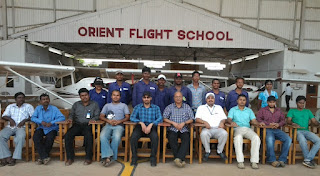
          Orient Flight s published schedule of refresher course is going to be conducted on 15th and 16 march.               Continuation training(Refresher Course) is one of the requirement for renewal of AME licence by DGCA or renewal of Certification Authorisation by Quality Dept in any organisation.              Continuation training is a two way process to ensure that certifying staff remain current in terms of procedures, human factors and technical knowledge and that the organisation receives feedback on the adequacy of its procedures and maintenance instructions.               Due to the interactive nature of this training, consideration should be given to the possibility that such training has the involvement of the quality department to ensure that feedback is actioned.              There should be a...

MONSOON OPERATIONS TRAINING

Image
                   Adverse weather is an integral part of flight operations. Adverse weather prevails in one part of an operator’s network or another at different times of the year. In India, monsoon period is a defined period of adverse weather.  Despite the annual occurrence and predicted regularity of the Indian Monsoon, aviation incidents/ accidents occur every year.                  Analysis has shown that most of the incidents and accidents, that have occurred, were not generally attributable to inadequacies in aircraft performance but occurred mostly due to various deficiencies/shortcomings of the human element. Operating techniques applicable to each aircraft, under various generic adverse weather conditions, exist in flight manuals and must be adhered to. However, to ensure an enhanced level of safety, the reinforcement of these operating practices in the context of the Indian ...

Type examination

 Type examination standard where type training is not required: The examination must be oral, written or practical assessment based, or a combination thereof. Oral examination questions must be open.  Written examination questions must be multiple-choice questions. Practical assessment must determine a person's competence to perform a task.  Examination subjects must be on a sample of subjects drawn from  type training/examination syllabus, at the indicated level. The examination must ensure that the following objectives are met: Properly discuss with confidence the aircraft and its systems. Ensure safe performance of maintenance, inspections and routine work according to the maintenance manual and other relevant instructions and tasks as appropriate for the type of aircraft, for example troubleshooting, repairs, adjustments, replacements, rigging and functional checks such as engine run, etc, if required. Correctly use all technical literature and docume...

Type training - Element

Type training must include a theoretical and practical element. Theoretical element As a minimum the elements in the Syllabus below that are specific to the aircraft type must be covered. Additional elements introduced due to technological changes shall also be included. Training levels are those levels defined in paragraph 1 above. Personnel desirous of obtaining Category / Sub-category “A” licence with type rating shall pass appropriate type examination conducted by DGCA or where applicable shall successfully complete an approved type training. Under the later circumstances the level of training shall be a level lower than the one described below for a B1 Category type course. After the first type course for category C certifying staff, all subsequent courses for extension in the same category need only be to level 1 standard. General Aircraft(dimensions/weights MTOW etc) Time limits/maintenance checks Leveling and weighing Towing and taxiing Parking/mooring Servicing Sta...

Type training - Levels

The three levels listed below define the objectives that a particular level of training is intended to achieve. Level 1 General familiarization A brief overview of the airframe, systems and powerplants as outlined in the Systems Description Section of the Aircraft Maintenance Manual. 1. Course objectives: Upon completion of the course, the student will be able to identify safety precautions related to the airframe, its systems and powerplant. 2. Identify maintenance practices important to the airframe, its systems and powerplant. 3. Define the general layout of the aircraft's major systems. 4. Define the general layout and characteristics of the powerplant. 5. Identify special tooling and test equipment used with the aircraft. Level 2 Ramp and transit Basic system overview of controls, indicators, principal components including their location and purpose, servicing and minor troubleshooting. Course objectives:  the student will be able to: 1. Recall the safety precauti...

Continuation training

Continuation training   is one of the requirement for renewal of AMEL by DGCA or renewal of Certification Authorisation by Quality Dept in any organisation. Continuation training is a two way process to ensure that certifying staff remain  current in terms of procedures , human factors and technical knowledge and that the organisation receives feedback on the adequacy of its procedures and maintenance instructions.   Interactive nature of continuation training, provide possibility of involvement of the quality department to ensure that feedback is actioned.  Procedure is required to ensure that feedback is formally passed from the training department to the quality department to initiate action. Content of continuation training  should cover changes in relevant requirements such as  CAR-145 , changes in organisation procedures and the modification standard of the products being maintained plus human factor issues identified from any internal...